
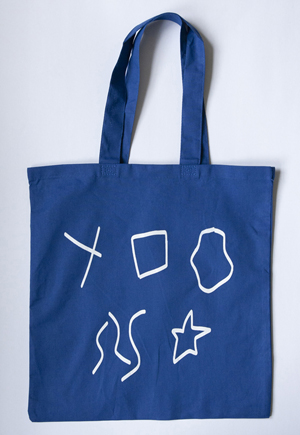
Zener cards were developed by perceptual psychologist Karl Zener to use in experiments conducted with parapsychologist J. B. Rhine in the 1930s. Intended for measuring extrasensory perception, the deck of 25 cards included five symbols: a Greek cross, a hollow square/rectangle, a hollow circle, three wavy lines, and a hollow five-pointed star. In 1935, Rhine sent a deck to Upton and Mary Craig Sinclair with the request that the clairvoyant Mrs. Sinclair try them out "if there is ever a time in the next hundred years for a little playful testing." Rhine's self-effacing sentiment foreshadows general skepticism of the deck's effectiveness. The bold zener symbols could often be seen through the back of the card, reflected in researchers' eyes or glasses, or easily guessed due to poor shuffling or subtle body language.
The Edna tote takes as inspiration sketches mistakenly remembered as the drawings of a female clairvoyant during a bout of ESP testing. From J.D. MacFarland and R.W. George, "Extra-Sensory Perception of Normal and Distorted Symbols," Journal of Parapsychology, I (1937), 93-101, researchers intentionally tried using badly distorted zener symbols to compare ESP results with the standard deck, anticipating that participants might miss the distorted symbols more often than the normal. From SurvivalAfterDeath.info: "There was also the possibility that the distorted symbols would arouse esthetic avoidance in the subject. No appreciable difference was found, however, except when the experimenter himself, MacFarland, acted as subject. It is indicated that grossly distorting the symbols does not reduce their perceptibility."
Designed with Emanuel Alec Ilagan; screen printed by Antler River Press. Created to celebrate Edna Press' first art book fair with 3/edition.
Currently out of stock